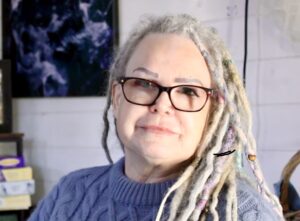
Maria Deane is a Bristol-based artist, poet, and author whose work explores healing, transformation, and the deeper emotional landscapes of human experience. Working across painting, writing, and spiritual practice, her creative process is guided by intuition, listening, and a deep sensitivity to energy. Her mixed-media artworks often emerge through a reflective dialogue with the canvas, allowing the work to evolve organically over time.
Alongside her visual practice, Maria works as a Reiki Master Teacher, hypnotherapist, and intuitive practitioner. Her work across art, healing, and storytelling is connected by a shared intention: transforming trauma into understanding, silence into expression, and personal experience into a space for reflection and growth.
Maria is also the author of Conversations with My Brother and Conversations with Shia Kana, and is currently preparing her forthcoming novel Where Silence Blooms, which continues her exploration of healing, resilience, and inner transformation.
In this conversation with The Creative Voice Archive, Maria reflects on the deeply interconnected nature of her creative and healing practices. She speaks about how painting, writing, and intuitive work form a single creative thread within her life, each medium offering a different way of listening to inner experience.
The discussion moves through themes of grief, storytelling, spiritual awareness, and the role of creativity as a form of healing. Maria also shares the origins of her book Conversations with My Brother, written following the loss of her sibling, and how that experience shaped both her writing and her wider understanding of purpose, intuition, and personal transformation.
Throughout the interview, Maria describes creativity not simply as artistic expression, but as a process of listening, to the canvas, to one’s inner voice, and to the experiences that shape our lives.
You can follow Maria Deane here :
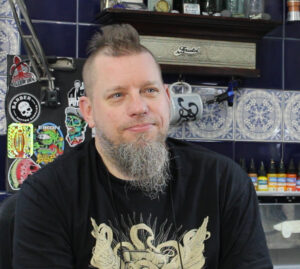
Ben Boston is a Bristol-based tattoo artist whose practice is rooted in drawing, craft, and long-term visual thinking. With decades of experience, Ben’s work sits at the meeting point of traditional tattooing and personal artistic development, combining composition, storytelling, and a deep respect for the human body as a living canvas.
From early childhood, Ben was constantly making images, supported by family who encouraged his creativity with materials, space, and time. That early analogue, hands-on foundation never left him. Before tattooing became his profession, he was already thinking like a maker, drawing, building, experimenting, and learning how images sit on real surfaces rather than flat ones.
Over the years, Ben has developed a reputation not only for the quality of the tattoo work itself, but for the calm, attentive “chairside manner” that tattooing requires: the ability to hold space for people during a vulnerable process, and to treat each tattoo as something that carries personal meaning, memory, and identity.
This interview was recorded inside Ben’s tattoo studio, so there is some background sound, but it also gives the conversation a real sense of place, the environment where the work actually happens.
Ben reflects on the beginnings of his journey: drawing from childhood, early recognition through school, and the moment he realised he couldn’t live a non-creative life. After leaving a job that felt stifling, he took the risk of walking into tattoo spaces with his portfolio, experiencing the “closed shop” reality of the industry at the time, and eventually finding the right doorway into apprenticeship.
We talk about what it felt like the first time he put ink to skin, the nerves, the permanence, and the gradual progression from colouring and assisting, to outlining, to completing full tattoos. Ben shares how tattooing is a form of learning that never ends: skin changes across the body, across individuals, with age, and with life.
A key theme of the conversation is meaning and longevity. Ben speaks openly about trends, how fashions come and go, and how tattoos rooted in genuine connection tend to last, emotionally and visually, far better than what’s popular in the moment. The interview also touches on memorial tattoos and the quiet power they can hold: small pieces that carry enormous weight, serving as living markers of love, grief, and legacy.
This conversation sits at the heart of what The Creative Voice Archive is documenting: creative practice as lived experience, not just what people make, but what it means, how it’s learned, and the relationships it creates across a city.
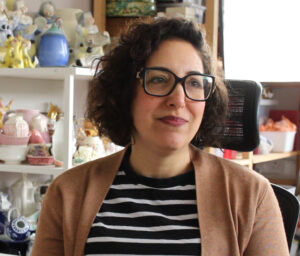
Yaarit Mechany is an artist and designer working with reclaimed and vintage ceramics, transforming forgotten objects into contemporary sculptural vessels. Her practice is driven by a fascination with the past, the traces people leave behind, the beauty embedded in decoration, and the emotional weight held inside objects that have already lived a life.
Originally from Tel Aviv and later based in London, Yaarit’s work has evolved through shifts in place, space, and access, moving from large-scale furniture and lighting into more intimate ceramic works shaped by collecting, preservation, and re-assembly. Her process often begins with instinct and memory: a hunt for forms, textures, and patterns that carry “age” and a sense of richness, before being carefully broken, rebuilt, and given a renewed purpose.
Yaarit also writes alongside her studio practice, documenting thoughts, process, and the realities of making a sustainable creative life.
In this conversation, Yaarit speaks about the emotional and cultural pull of reclaimed ceramics, and how her work holds collective memory, even when the objects are not tied to her own childhood. She reflects on moving from Tel Aviv to London, the financial and identity challenges of studying at the Royal College of Art, and how relocation shifted her practice from larger builds toward smaller, more detailed work.
She explores how her making is both precise and tender, even when it involves cutting and breaking objects, not as destruction, but as preservation and renewal. The interview also touches on the hierarchy between making, collage, and writing; the impact of motherhood and limited studio access; and the vulnerability of creating work that feels “feminine” within traditionally masculine making spaces.
We close with a grounded reflection on the long game: building a sustainable living from the work, returning to larger-scale objects, and learning to worry less and enjoy the path more.
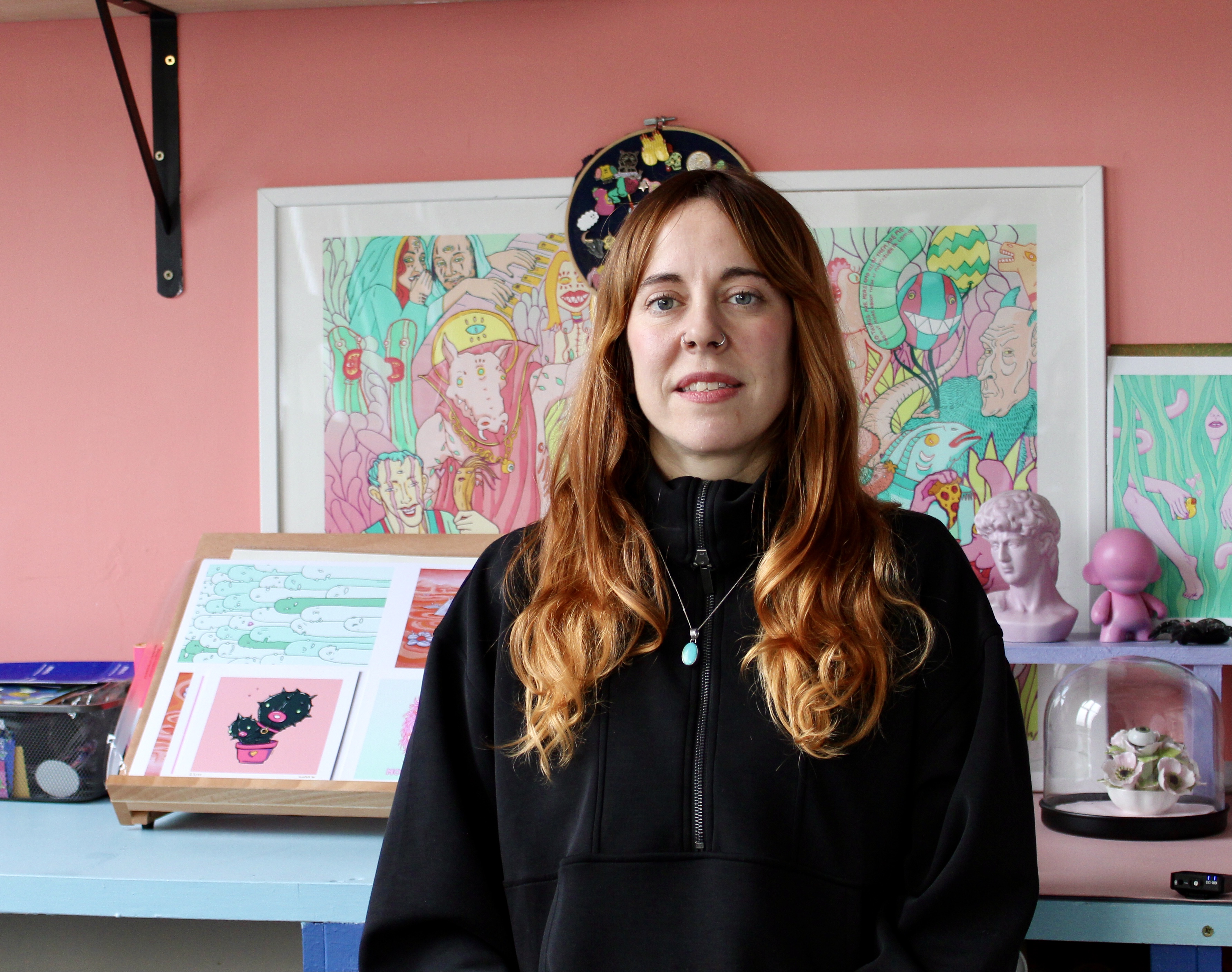
Marta Zeartha is a Bristol-based illustrator and multidisciplinary artist whose vibrant graphic work blends the everyday with the surreal. Using bold colour, playful symbolism, and character-led scenes, her work explores modern life with humour, curiosity, and emotional depth, often touching on themes like isolation, technology, and the pressure to connect in a digital world.
Originally trained in Fine Art in Seville, Spain, Martha later moved into graphic design and built a creative life in Bristol through a mix of hospitality work, music, and growing visibility online. Her practice is shaped by the city’s street art culture, Latin music communities, and her own evolving visual language, a style that has become recognisable through repetition, cohesion, and fearless experimentation across mediums.
In this conversation, Marta reflects on her early relationship with drawing, her classical Fine Art training in Spain, and the difficult reality of entering unpaid creative work, which led her to juggle design ambitions with function band singing just to pay the bills. She shares how moving to Bristol became a turning point: both creatively and personally, especially during a period of isolation where drawing became a way to express herself and connect with people through Instagram.
We talk about how music helped shape her visual identity, creating posters for Latin bands and Bristol events, and how that public-facing work led to real momentum. Martha also shares a major milestone: winning a competition that placed her design on the Bristol Pound, which opened doors to selling prints and products in local shops and building wider recognition.
The interview goes deeper into the “double-edged sword” of having a consistent style, how it helps visibility and cohesion, but can also feel limiting when you want to play, experiment, and grow. Martha speaks candidly about anxiety, imposter syndrome, and the pressure of social platforms, while still keeping her practice alive through murals, printmaking, painting, and new directions like animation in Procreate Dreams.
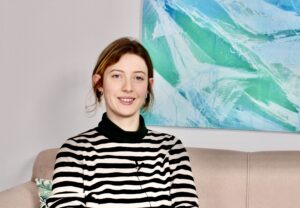
Jenny Brock is a Bristol-based artist and poet whose practice moves between visual work and language. Her paintings often sit in the space between the abstract and the personal, exploring inner landscape, memory, emotion, and the psychological atmosphere around solitude and belonging.
Jenny’s visual practice is rooted in ambiguity and nuance. She creates work that invites interpretation rather than delivering a fixed meaning, encouraging viewers to discover their own associations inside the image. Her approach is shaped by her interest in Romanticism and the Sublime, using contemporary process-led painting to explore awe, uncertainty, and the scale between the human and the natural world.
Alongside her painting, Jenny also writes poetry, including work that ranges from light-hearted family writing to more serious, therapeutic poems she has begun sharing through open mic nights. She also co-created a children’s anthology book with her mother, combining stories, rhymes, and illustration as a long-term collaborative project.
In this interview, Jenny speaks about wanting her work to be a unique personal experience for each viewer, where people can see different things in the same painting, sometimes even things she didn’t anticipate. She describes how her practice shifted from “making work for university” to something deeper when she discovered what truly inspires her: the Sublime, and the Romantic tradition behind it, referencing artists like Caspar David Friedrich and key works that shaped her thinking, including Monk by the Sea.
We explore Jenny’s process-led way of painting, beginning with chance and “happy accidents” (often through acrylic pouring) before responding to what emerges. She describes waiting, rotating, revisiting, and letting a piece reveal what it wants, rather than forcing an outcome too early. She also reflects on what changes over time: how life experience inevitably shows up in the work, even when it isn’t deliberate.
Jenny shares openly about grief and change, including the recent loss of her mother, how that has affected her emotionally, and how she has started to notice themes of isolation, anticipatory grief, and self-reliance already present in her work long before she consciously recognised them. The conversation also moves into her writing life: the relationship between poetry and painting, performing poems at open mics, and her desire to bring the collaborative book she made with her mother into the world more fully as part of preserving her mother’s voice and legacy.
.